by Stephanie Williams
For NYC designer Noa Rawitz, clothing begins with an emotion far more than strict logic. It might emerge from the texture of a fabric, the glowing atmosphere of a beautiful landscape, or an inspiring story rooted in mythology. Whatever the starting point, her creative process is guided by a desire to translate the intangible into a liberating form that a woman can experience on her own body.
Drawing on sensual silhouettes, fluid draping, sheer fabrics, and intricate craftsmanship, Rawitz creates a world where femininity is not a fixed ideal but an evolving form of self-expression. Her designs explore the relationship between clothing and emotion, inviting women to feel comfortable, confident, and connected to themselves.
Regardless of variance in mood, Rawitz recognizes that women need to feel like extensions of themselves when dressing up. She feels that dressing well and dressing “for yourself” can be a way to change your posture, a way to experience and immerse yourself more in life.
Rawitz reflects on her ability to change her persona depending on her mood and clothing choices coinciding with that. “Some days I want to be a tomboy, other days I want to be a f***ing princess,” she comments.
But that’s not where her curiosities begin or end.
Her true journey into fashion began with a personal connection to handmade textiles – particularly, with dye and natural means. Fabrics found at her mother’s and grandparents’ homes helped spark an early fascination with the possibilities of making clothing. Over time, that curiosity developed into a design practice shaped by her experiences in Tel Aviv, New York, and London, as well as her ongoing interest in the stories and emotions that influence how women see themselves.
“I had always been drawn to making clothing […] and, particularly with silk dresses and sheer pants, I created clothing for my dolls from the time I was a child,” Rawitz reflects.
Finding Femininity Beyond a Single Definition
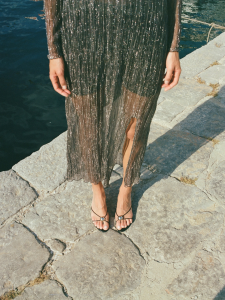
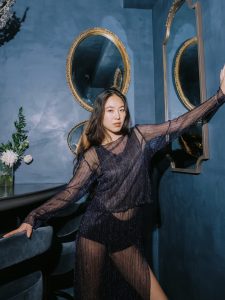
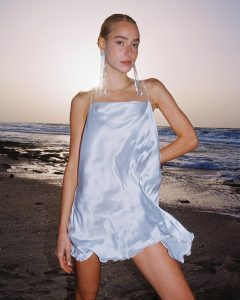
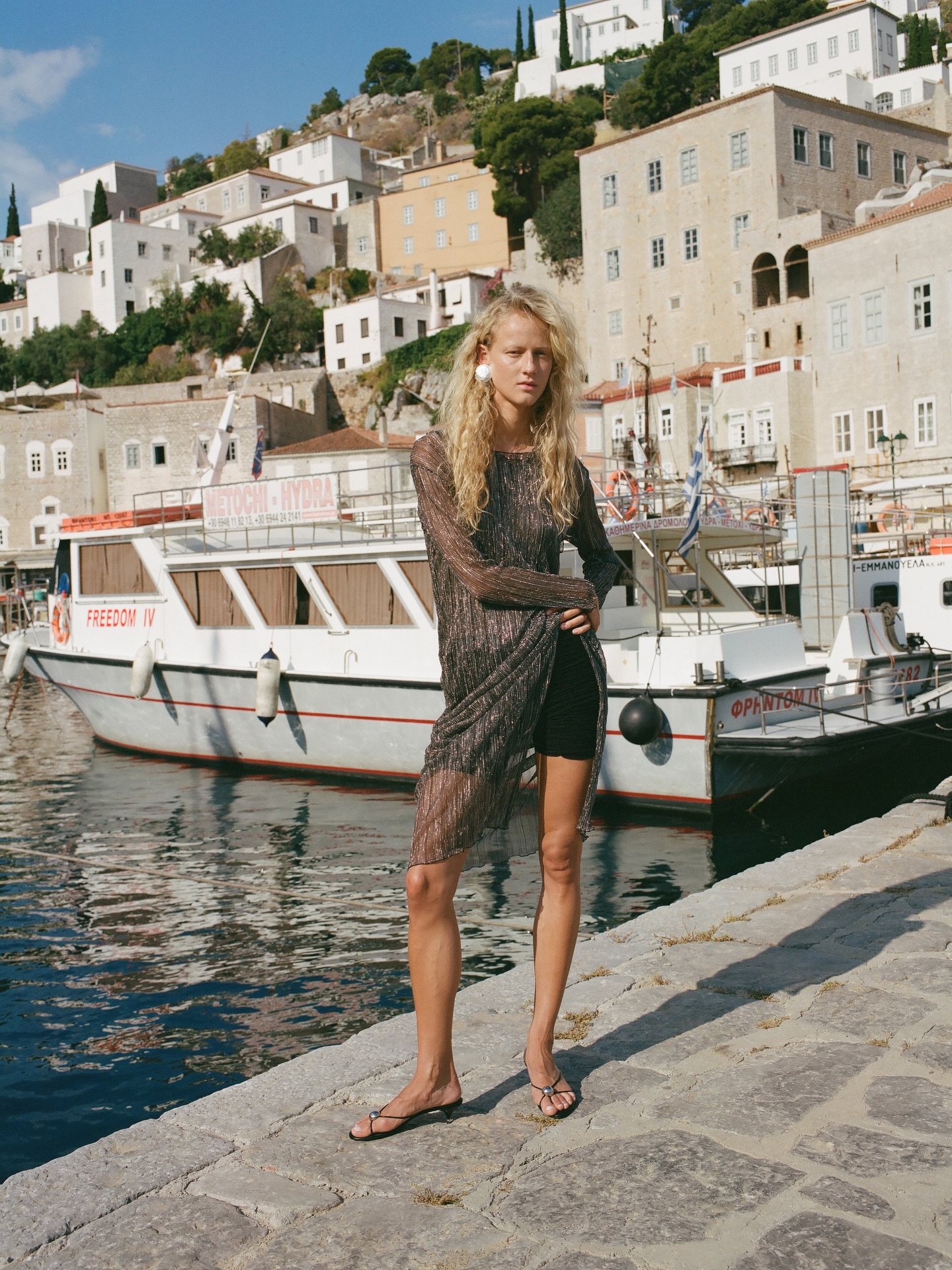
Rawitz’s design language is deeply connected to the female body, but her approach to femininity extends beyond conventional ideas of what feminine clothing should look like. She gravitates toward silk dresses, sheer trousers, open backs, and fluid silhouettes that move with the body rather than restricting it.
The way a garment feels is just as important as how it appears. Through bias cutting, carefully considered draping, and layered textures, she explores how fabric can interact with the body in a way that feels natural and expressive. Even when incorporating sheer materials, she considers how the garment will feel against the skin, including the use of sheer linings.
Her designs resist the idea that women must be cinched in or reshaped to fit a particular ideal. Instead, comfort and sensuality exist alongside one another, allowing the wearer to decide how she wants to present herself.
That flexibility is central to Rawitz’s understanding of femininity. It can be delicate, powerful, playful, dramatic, or understated. It can change from one day to the next. As she puts it, “Sometimes I want to be a tomboy, other days I want to be a f***ing princess.”
Rather than treating these expressions as contradictions, Rawitz embraces their coexistence. Her work makes room for women to move between different versions of themselves without having to choose one identity and remain there.
Where Mythology Meets Personal Storytelling
Storytelling is another essential part of Rawitz’s creative world. Her recent collections draw inspiration from Greek mythology, exploring female figures and narratives that raise questions about women’s representation, identity, and freedom.
For Rawitz, these stories offer more than visual references. They create opportunities to connect with characters whose experiences may reflect something deeply human, even when their worlds are far removed from our own. She describes this search for connection as looking for a soul sister within a story: a figure whose experiences or emotions make her feel understood.
Her recent work moves beyond her earlier exploration of the Sirens, drawing on elements of the myth of Pan and Syrinx. In the myth, Syrinx attempts to escape Pan by transforming into reeds, which he then uses to create his musical instrument. The story intertwines transformation, music, creativity, and a woman’s attempt to preserve her freedom.
It is a narrative filled with tension as much as suspense and drama. Transformation becomes a means of escape, yet the ending complicates the idea of freedom. By drawing from mythology in this way, Rawitz can explore the emotional complexity of female experience through silhouette, texture, and form rather than relying on literal representations of the characters.
“I want women to feel [inspired] to feel comfortable in their own bodies as a result of being exposed to my work,” Rawitz states. “I want them to feel safe to express who they are as a result of being exposed to my collections.”
The result is clothing informed by a larger narrative, where each design can carry its own interpretation. The story provides a starting point, but the wearer brings her own experiences and identity to it.
The Craft Behind the Feeling
Although Rawitz’s work has an elegant, dreamlike quality, achieving that effect requires considerable technical attention to detail. Her process involves researching a concept or theory that resonates with her, collecting visual references, developing mood boards, sketching silhouettes, experimenting with draping, and refining patterns, fit, and construction.
While this process may sound like one that all or most designers begin with, Rawitz is quite methodical and intentional in the way she approaches both her process and product. Her approach to process can involve visuals but lately it’s also involved inspiration from literature, she says.
Textures, colors, and landscapes help establish the atmosphere of a collection. Rather than gathering images simply because they look beautiful, she looks for references that evoke a shared feeling or suggest a world she would like to explore.
From there, designs evolve through sketches, variations, and hands-on development. Rawitz works in her own studio, allowing her to remain closely involved in the making of each piece, from the initial fabric selection to the seams and finishing details.
While she once utilized outside factories and made her own technical fashion flats, Rawitz also expands on how she has evolved as a designer over time. “I once made technical fashion flats and sent, but am now more keen on making my own designs, so I don’t [feel the need to] use them anymore,” Rawitz remarks.
For her, craftsmanship carries an almost therapeutic quality. The time spent refining a garment is part of the creative experience, and the smallest details matter, even the most seemingly mundane ones. A design should photograph beautifully, but its success cannot end with the image. “A real woman needs to be able to wear it, move in it, and feel good in it,” Rawitz says.
The best garment isn’t just about the way it looks, but about the way it makes you feel – whether it’s the way that it physically moves against your skin, or the vibe it gives you, adds Rawitz.
That balance between visual impact and physical experience is what gives the work its purpose. The garment is not simply an image to be admired; it is a facet meant to become an important aspect of someone’s life.
Developing an Independent Point of View
Rawitz’s perspective has also been shaped by moving among various creative environments. Originally an international designer, she later moved to New York, studied at the Fashion Institute of Technology, and spent a semester at Central Saint Martins in London. Each place offered a different perspective on styling, creativity, and fashion, and she took from each experience what felt most meaningful to her.
At Wanderobe, we believe that travel contains that sense of place, and that perspectives change depending on what you’re wearing – but also on what you’re wearing in connection to the setting in question.
Rawitz claims that “the sense of fashion in New York is very different from the fashion styles in Tel Aviv,” for instance.
Rather than allowing those influences to dictate a fixed aesthetic, she has continued developing a point of view that feels personal yet painfully honest. Following trends can be challenging when they do not align with the ideas she wants to communicate. That’s why Rawitz struggles to follow trends in general, even on social media. But for Rawitz, the goal is not to reject outside influences altogether, but to build a design language that can evolve without losing its authenticity.
That evolution also involves remaining curious despite the world’s obsession with trends. Art, commissions, new techniques, and subjects that excite her intellectually can all become starting points for future work. Travel offers another opportunity for true, in depth novelty and discovery.
Her approach to discovery is ultimately emotional as much as visual. She follows the subjects that make her feel a deeper emotion than what she started with, then explores how that response might translate into clothing.
Clothing as a Form of Self-Recognition
For Rawitz, the relationship between clothing and identity extends beyond the garment itself. What we wear can influence our posture, our mood, and our willingness to take up space. A piece that makes someone feel more confident or open to a new experience can change how she moves through the world, while also influencing how others perceive and respond to her.
This is why the experience of wearing a design matters so vastly. Rawitz wants women to feel beautiful and comfortable in their own bodies, with the freedom to express themselves without worrying about whether their femininity fits someone else’s expectations.
She also understands that clothing can become intertwined with memory. A particular scent, texture, or silhouette can recall a first date, a proposal, or another moment that remains meaningful long after it has passed. A garment can become part of the story of an experience, carrying the emotions associated with it well into the future.
That lasting connection is what makes fashion personal. Beyond its construction or appearance, a piece can become a reminder of who someone was, how she felt, and what she experienced while wearing it.
In Rawitz’s world, femininity is never a singular destination. It is something women can discover, reinterpret, and express in countless ways. Through mythology, meticulous craftsmanship, and an instinct for clothing that feels as good as it looks, she creates space for that individuality to exist.
The most meaningful garment, perhaps, is not the one that tells a woman who to become. It is the one that helps her recognize something in herself.
Rawitz’s connection to design is not just one dimensional. It is multi dimensional and multi-faceted, which is where she fits in as a designer for Wanderobe’s platform. She is well aware that feminine beauty contains many facets and dimensions.
In the same way that femininity can’t be restricted to one dimension or form, Rawitz recognizes that having a “sense of place” is integral when it comes to a sense of exploration, travel, and discovery. She acknowledges that the beach is her “safe harbor” and encourages all women to find their safe space.